Second Looks and Secret Places, Tokyo
Why do you keep going back? It’s a question I get asked a lot—one that needs no answer, but if I were to attempt to answer it beyond the obvious—it would have something to do with the value of second looks. Consider the words of early 20th-century French novelist Marcel Proust: “The real voyage of discovery consists not in seeking new landscapes, but in having new eyes.” Revisiting the same places with a new perspective can be just as illuminating, if not more so, than venturing elsewhere. To me, it often means having a deeper, richer experience.
In How Proust Can Change Your Life, Alain de Botton writes, “The happiness which may emerge from taking a second look is central to Proust’s therapeutic conception, it reveals the extent to which our dissatisfactions may be the result of failing to look properly…rather than the result of anything inherently deficient about [our lives].” He goes on to say, “Appreciating the beauty of [one thing] does not preclude our interest in [another], but failing to do so must call into question our overall capacity for appreciation.” While beauty is clearly apparent in, say, Mt. Fuji, it is equally manifest, though perhaps more subtly, in the numerous streets of Tokyo.
Honing my aesthetic sense and leveraging past experiences to affect more meaningful encounters is what motivates me the most. Combine this with the fact that Japan still very much feels like a dreamworld (even after all this time) and the reasons I return (and long to return) gradually become clearer. From tea ceremonies to photography workshops, these are the kinds of experiences that capture my imagination. There is a reason why so many others feel the same (popular economics blogger Noah Smith, for one, who described Tokyo as the new Paris). Returning to the city rekindled my own affinity for it.
Return to EDITION (and More)


The first of many returns began with the Tokyo EDITION, Toranomon, one of my favorite places in all of Tokyo. Through a marble-clad passageway—a portal, really—and a climatic elevator ascent, visitors are transported to a floating urban oasis. Enveloped once again in Le Labo’s Thé Noir, a rich scent of bergamot and black tea featured throughout EDITION hotels, I was overcome with a wave of memories. This would not be the first time a sensory experience would transform a moment, but it was certainly no less impressive. While EDITION, Toranomon will forever have my affection, its sister property, EDITION, Ginza, is no less delightful.
Admittedly, the latter once felt like the lesser of the two. It’s smaller, and unlike EDITION, Toranomon, it features neither a spa nor views of the city’s skyline. However, the charm of EDITION, Ginza lies precisely in its more intimate and refined take on the brand’s iconic, minimalist design. An assortment of ivory-colored textiles compliments floor-to-ceiling walnut wood in the lobby. The defining focal point is a sleek white staircase leading up to the Punch Room, a cozy cocktail bar. While the Punch Room was closed when I visited, this only presented an excuse to return, an opportunity for a second look.
In a fascinating interview with Wallpaper*, architect Kengo Kuma explains, “The back streets, or uradori, [of Ginza] are more vibrant and active, often only wide enough for humans. That kind of hidden feeling is the basis of Ginza,” and, in turn, EDITION, Ginza. The property’s seamless integration into the surrounding neighborhood, courtesy of Kuma and EDITION founder Ian Schrager, means that it retains a somewhat inconspicuous quality. That the streetside entrance gives way to such a space within is pleasantly surprising. You really feel as if you have stepped into another world.
So, what was I doing there if not to check in? The answer, of course, was to have afternoon tea at Sophie, a modern brasserie on the 14th floor. Adorned with wasabi green upholstery and bright natural light, the space brims with energy. A collection of monochromatic prints showcasing the vibrant personalities of Ginza and its uradori mirrors the crowd of Tokyo socialites and international travelers alike. If nothing else, sipping a cup of genmaicha (green and roasted brown rice tea) made for an excellent people-watching experience.
***
Returning to Tokyo similarly reunited me with the works of Japanese contemporary artist Yayoi Kusama. In the nearby Ginza Six, a popular luxury shopping complex, I finally acquired a replica of her iconic yellow pumpkin. I was fortunate to see the lifesize version at her museum in the neighboring district of Shinjuku—the third pumpkin of hers I’ve seen, the first being in Washington, D.C., the second in Naoshima. This second look at one of my favorite artists also revealed the poem “Beyond Art.” Had I never returned, I may never have discovered the words that connected with me most: “I am determined to keep fighting ever more vigorously. To the best of my ability, and with all my might, I will keep fighting. With all my might.”
In the same way, I am determined to return (again). The epiphanies of second looks and the lure of secret places lead the list of reasons why. Another contender is Japanese tea culture (more on that below). I’m reminded of all the observatory decks I visited—from Tokyo City View in Roppongi Hills to Shibuya Sky in Shibuya—and how each one provided a different glimpse of the city, as if rendering a more complete picture of Tokyo. Each time I’ve visited, it’s had a similar effect, offering a clearer picture of the metropolis.
Tea Time


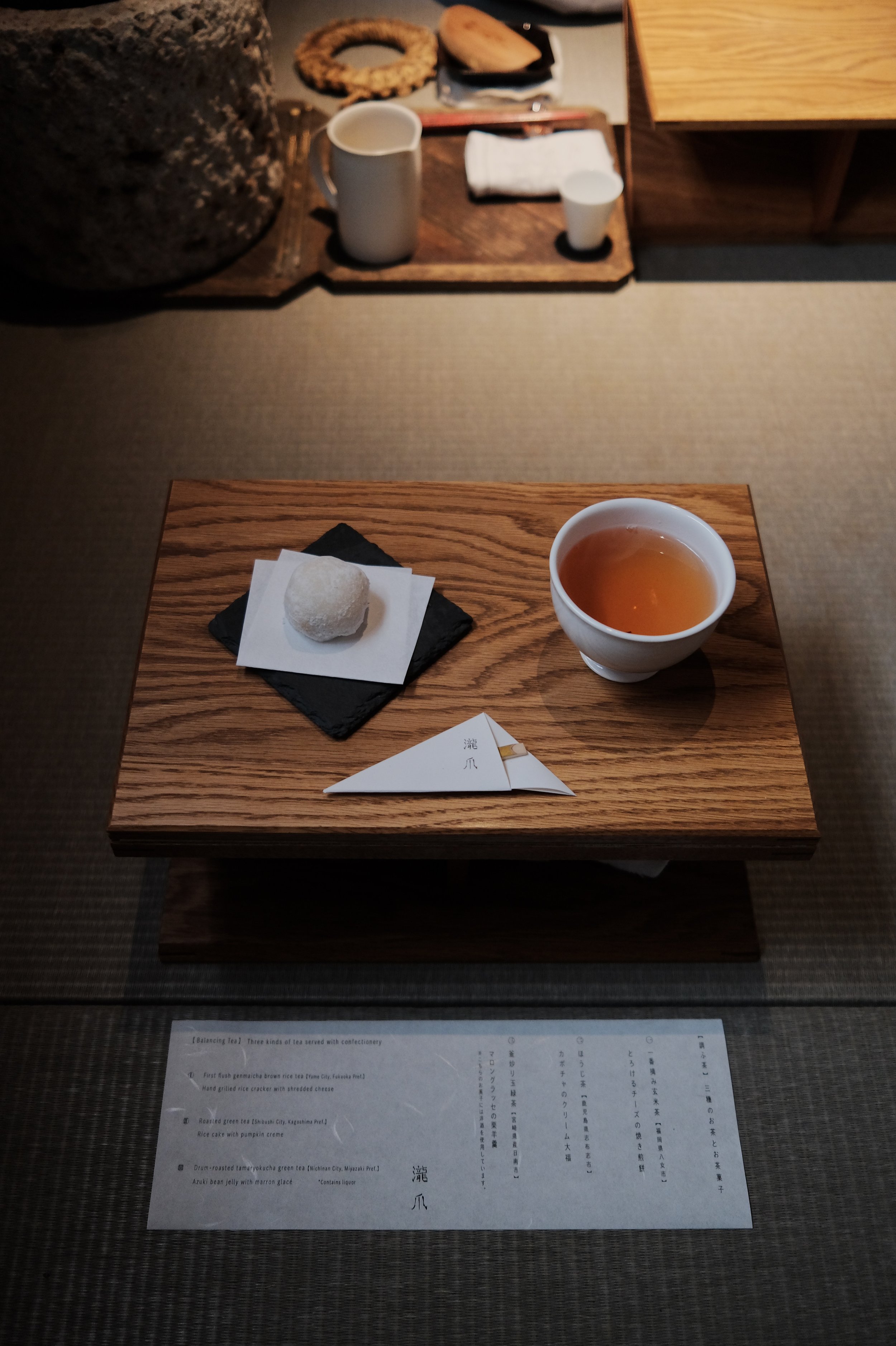


In a quiet residential area of Shinagawa, down an unsuspecting alley, almost hidden in plain sight, lies Takizme, a cozy tea house and home to one of the most memorable experiences I’ve ever had. Passing through the entranceway garden, or roji, with its majestic persimmon tree, I wondered how such a place could exist, removed from the energy of the city. Inside, surrounded by sunlit shoji screens and the fragrant incense of palo santo, it was clear that I had discovered a secret place. As my host instructed me to begin to clear my mind, I found myself grappling with a desire to document the moment but at the same time to exist fully in it.
Each time my mind wandered, I directed my attention back to my breath. Gradually, the tension that had accumulated over two weeks from shuffling through countless trains and taxis, from altered circadian rhythms, and, admittedly, an incessant stream of negative mental chatter, subsided. My stomach rumbled. I felt myself yawn—a telltale sign that I had entered an increasingly rare but long-coveted parasympathetic state, and, in doing so, a newfound appreciation for Japanese tea culture emerged. Guided by my host, tea master Takuya-san, I focused on the long and changing aftertaste of my second tea, a hojicha or roasted green tea. A seasonal sweet, a rice cake filled with pumpkin creme, complimented its rich, smoky flavor.
Once again, Proust’s words came to mind: “No sooner had the warm liquid…touched my palate than a shiver ran through me and I stopped intent upon the extraordinary thing that was happening to me. An exquisite pleasure had invaded my senses, something isolated, detached, with no suggestion of its origin. And at once the vicissitudes of life had become indifferent to me, its disaster innocuous, its brevity illusory...I had ceased now to feel mediocre, contingent, mortal.” Such is the power of tea. Engaged in the present, fully immersed in the tea ceremony before me, nothing else mattered, not the trials and tribulations of tomorrow or ruminations about the past.
Instead, I studied the precise movements of Takuya-san, each one incredibly calculated, as he poured from teapot to teacup or gently bowed before serving the latter. For the third and final tea, guricha, a green tea with tart, berry-like notes, the teacup featured a prominent gold vein characteristic of kintsugi or the art of repairing broken ceramics. The idea, Takuya-san explained, was that embracing flaws and imperfections could produce something stronger and more beautiful. Painstakingly, over hundreds of hours, he had fused the broken pieces together, resulting in something that was truly unique. By the end, I had learned so much, and I was better for it.
Exit Dreamworld
Shortly before departing Haneda, and in preparation for the long flight ahead, I decided to download some music. One album in particular peaked my interest, a new release from Stockholm-based electronic producer and DJ, Prof. Stranger. Somehow, unexpectedly, Club Stranger became the soundtrack to my exit. The penultimate track, “At The Bus Stop Waiting (Interlude)” resonated most with its distorted, almost hypnotic vocals exclaiming, “I don’t want to wait for the weekend, I want to party right now.”
As I ventured back to the land of responsibility (i.e., reality), it was a notion that reverberated sharply—not because I wanted to remain in the kind of perpetual dream state of being a tourist in Japan (I did) but because of the implicit sadness that is linked to exiting that state, of passing through the portal that connected my world with the one there. I must have listened to the track a hundred times, slipping in and out of consciousness, the hours seeming to disappear at an accelerated pace each time I woke and glanced at the flight screen. My recollection of the experience is cloudy at best; the whole thing was reminiscent of a dream.
The fact that I remember so little seemed to bolster the idea that these worlds were, in fact, connected by a liminal space, a transitional area, neither here nor there. It felt like something from a Huraki Murakami novel. What does it mean to long to return, and what is it about Tokyo and its ability to continuously arrest my imagination? These were the things I thought about, and as I did another standout track from Club Stranger, this one markedly different in tempo and tone, triumphant even, resounded through my headphones: “I’m Ready to Go Again.” I knew it was only a matter of time.